
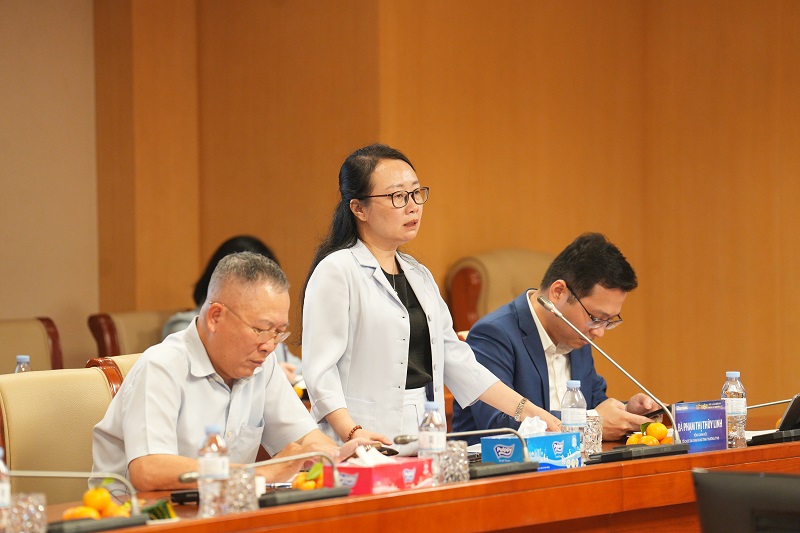
(Remarks delivered at the Roundtable “Savings – An Endogenous Strength in the Digital Era,” organized by Banking Times on the occasion of World Savings Day, 31 October)
The National Financial Inclusion Strategy to 2025, with a vision to 2030, clearly defines its core objective: “All citizens and enterprises, especially vulnerable groups, are able to access and use financial products and services safely, conveniently, and at reasonable cost, in accordance with their needs.” The Strategy also underscores the importance of enhancing financial knowledge, capacity, and skills among the population, enabling people to proactively, safely, and effectively choose and use financial services.
In this context, micro-savings is regarded as a key pillar in realizing the objectives of the National Financial Inclusion Strategy. Even small savings form the foundation of financial security, enabling individuals and households to better cope with life’s uncertainties while facilitating deeper participation in the formal financial system.
However, for poor women and vulnerable communities, changing perceptions and building savings habits is far from easy. They often face difficult trade-offs between meeting immediate essential needs and saving for the future. Therefore, developing micro-savings models—small, regular deposits tailored to income levels—has become a crucial key to helping them gradually achieve financial autonomy and stability, while contributing to the effective implementation of the National Financial Inclusion Strategy.
Founded in 1992 by the Vietnam Women’s Union and licensed by the State Bank of Vietnam in 2010 as the country’s first officially recognized microfinance institution, TYM has been a pioneer in bringing formal financial services to poor women and vulnerable communities. For more than three decades, TYM has not only provided small loans for livelihood development but has also helped establish and sustain a culture of micro-savings, where every small deposit embodies trust and the aspiration to rise among poor women and vulnerable groups.
- Micro-savings: Concept and Role
In recent years, alongside the development of financial inclusion, micro-savings has increasingly been recognized as a practical solution enabling citizens—especially women and vulnerable groups—to access and participate in the formal financial system.
Micro-savings refers to the accumulation of small but regular amounts of money, designed for individuals with low and unstable incomes or those living in rural, remote, or disadvantaged areas. Alongside microcredit, micro-savings constitutes one of the core pillars of microfinance.
Where savings were once understood simply as setting money aside, in today’s financial inclusion context, micro-savings carries a broader meaning. It is a tool that helps people learn how to manage income, plan expenditures, and save for the future—whether to cope with unexpected risks or to achieve long-term goals such as children’s education, healthcare, or household economic development.
For poor women and vulnerable communities, micro-savings also carries profound social significance by helping them:
- enhance financial autonomy and reduce dependence on others;
- build reserves to cope with hardships and avoid falling back into poverty; and
- most importantly, develop confidence in themselves—the belief that they can manage and improve their lives through their own efforts.
Over the years, the State Bank of Vietnam has consistently encouraged and facilitated savings activities among microfinance institutions, recognizing savings as an essential component of the National Financial Inclusion Strategy. TYM’s experience demonstrates that when women and low-income individuals are given access to appropriate savings services, they do not merely save to protect themselves but also accumulate capital to invest in their future, their families, and their communities.
- Micro-savings in Practice at TYM
From its inception, TYM has clearly identified savings as a foundation that goes hand in hand with credit in its mission to support poor women in economic development, sustainable poverty reduction, and enhanced social status.
While banks and traditional financial institutions often target customers with stable incomes, TYM’s micro-savings model takes the opposite approach—simple, accessible, flexible, and centered on poor women. TYM does not wait for the poor to come to it; instead, it proactively reaches villages, households, and individual women to provide loans, savings services, and long-term accompaniment on their journey toward self-reliance. To do so, TYM had to “map poverty,” identifying areas most in need of support. At that time, microfinance was still a new concept in Vietnam, and many doubted whether poor women, struggling to meet basic needs, could possibly save. Yet TYM’s practice proved otherwise: the poor can save if they are properly guided, supported, and encouraged.
In its early years, to become TYM clients, women were required to participate in five basic training sessions covering household financial management, loan and repayment rules, savings principles, and a final assessment interview. Initial loans were very small—just enough to test a small-scale production or trading activity—but every loan was accompanied by savings. Alongside borrowing, women began making weekly savings deposits at local group meetings organized by TYM within their communities. Deposits were sometimes as small as VND 3,000, 5,000, or 10,000 per period—the price of a bundle of vegetables or a packet of salt—but they marked the beginning of a savings habit and the belief that poor women could also save for the future. This model helped women save time and travel costs while instilling financial discipline, regardless of income size. For many, a few hundred thousand or a few million dong may seem modest, but for poor women, such savings represent self-protection—a reserve for illness, crop failure, or children’s education.
TYM helped women understand that savings is not what remains after spending, but what should be set aside first. This approach has enabled tens of thousands of women to obtain their first savings passbook in their own name—a tangible outcome of discipline, effort, and trust in the future. As a result, clients not only maintain excellent credit discipline (with TYM’s repayment rate consistently exceeding 99.9%) but also accumulate capital for production and build personal and family savings.
What distinguishes TYM is not merely the provision of financial services, but the transformation of perceptions about the value of savings. Where many women once believed that only the wealthy could save, they now understand that savings does not begin with surplus, but with determination and future orientation. Every small deposit is carefully recorded and updated by TYM staff at group meetings. With savings, women gain confidence in household financial decisions, reduce dependence on husbands or relatives, and take greater control of their lives. Many TYM clients have saved enough to expand shops, invest in livestock, or simply secure a reserve for their children’s future.
The year 2010 marked a significant milestone when TYM was licensed by the State Bank of Vietnam, becoming the first organization in Vietnam authorized to mobilize public savings. Since then, TYM’s savings operations have expanded in scale and form, including:
- Compulsory savings linked to loans, reinforcing regular saving habits;
- Voluntary savings with flexible deposits and withdrawals;
- Term savings designed for specific financial goals such as education, home repairs, or equipment purchases.
These products are designed to be simple, safe, convenient, and appropriate to clients’ capacities. Financial education remains a cornerstone of TYM’s approach. Through group meetings, training sessions, and thematic activities, women are guided in budgeting, expenditure planning, savings goal-setting, and risk management. These seemingly basic skills are essential in enabling women to make informed choices and, above all, to believe in their ability to save for the future.
By September 2025, TYM’s total savings balance exceeded VND 2.3 trillion, more than 30 times higher than in 2010. TYM currently serves over 222,000 clients, 100% of whom participate in savings. Savings balances account for approximately 70–80% of total outstanding loans, with annual growth of 8–10%, reflecting rising demand and growing trust. Average savings per client increased from VND 1.2 million in 2010 to over VND 10 million in 2025, evidencing not only financial growth but also a profound transformation in financial behavior among hundreds of thousands of poor women.
- Savings in the Digital Era
As the digital economy expands, digital transformation presents major opportunities to advance financial inclusion, bringing financial services—especially micro-savings—closer to people in rural, mountainous, and remote areas.
For microfinance institutions like TYM, this is not only an inevitable trend but also a pathway to narrowing the digital divide between the poor and the formal financial system.
Recognizing this, TYM has proactively implemented digital solutions in its savings operations, notably developing the TYM Mobile application, which enables clients and staff to access financial information and register services conveniently. Through the app, clients can check balances, monitor accounts, receive transaction notifications, and manage savings transparently and efficiently. Many rural women have, for the first time, accessed formal financial services and acquired basic digital skills. From 6,700 users in 2022 (3.5% of clients), TYM reached nearly 116,000 digital clients by September 2025, representing over 52% of its total clientele.
TYM also promotes cashless transactions. By September 2025, nearly 113,000 clients used non-cash payment methods, accounting for over 51% of all clients. In September 2025 alone, transaction value via accounts exceeded VND 334 billion, representing 52% of total client transactions.
For TYM, digital transformation is not merely about technology but about transforming clients’ capacity and mindset. Alongside infrastructure investment, TYM prioritizes digital financial education, integrating training on safe technology use, fraud prevention, and financial management. To date, over 80,000 clients and family members have received digital capacity-building training.
- Policy Recommendations
Drawing on more than three decades of experience, TYM affirms the growing importance of micro-savings in expanding financial access and strengthening financial autonomy for women and vulnerable communities. To further enhance its impact, TYM proposes:
- Continued improvement of the legal framework for microfinance and micro-savings, enabling more flexible digital, group-based, and goal-oriented savings products.
- Accelerated digital transformation in microfinance, including technological infrastructure support and digital capacity-building for staff and clients.
- Integration of financial and savings education into social welfare, rural development, and gender equality programs.
In today’s digital era, while technology transforms financial access, micro-savings retains its core values—empowerment, autonomy, and the gradual accumulation of hope for the future.
With appropriate policies, digital infrastructure support, and coordinated efforts, TYM believes that every small saving today can become the foundation for a more autonomous, equitable, and sustainable future for women and vulnerable communities.
Pham Thi Thuy Linh
General Director of TYM